
Understanding Montgomery County Releases
“Released” describes the end of one custody event. It does not always mean a person walked out free of all custody or supervision. Someone may leave the Montgomery County Jail on bond, recognizance, a court order, time served, sentence completion, or probation. A departure may instead be a transfer to the Kansas Department of Corrections, another county, a federal authority, or immigration custody. Death or hospitalization can also end a roster entry without being a community release. The actual release date, reason, and destination are therefore more useful than roster absence alone.
The Montgomery County Sheriff’s Office, or MCSO, holds the county booking and movement record. The Fourteenth Judicial District court holds the orders that explain the legal basis. Kansas VINE can report a custody change from a participating county jail. KASPER, the Kansas Adult Supervised Population Electronic Repository, covers people committed to or supervised by KDOC. Federal and immigration transfers require their own receiving-system checks. These records should agree on the person, booking or case, and event.
Montgomery County Release Types
Each label points to a different next record. Bond release means physical departure after bond terms are met, while the charges may remain pending. Time served or sentence completion ends the county confinement term, subject to any other hold. Parole and postrelease supervision occur after a state-prison term and leave KDOC supervision in place. Probation is imposed by a court and may follow a county stay without any state-prison admission.
| Release type | Meaning | Best next source |
|---|---|---|
| Bond or court order | County custody ends under court-set terms | MCSO release sheet and court journal entry |
| Time served or sentence complete | The county confinement duty is met, unless another hold applies | MCSO movement record and sentencing entry |
| Probation | The person is in the community under a court order | Court record and Adult Community Corrections |
| KDOC transfer | County custody ends and state custody starts | KASPER admission, location, and movement fields |
| Parole or postrelease | Prison custody ends but KDOC supervision remains | KASPER current status and parole-office location |
| Federal or ICE transfer | Another authority becomes custodian | BOP, federal docket, USMS, or ICE ODLS |
- Discharge
- The sentence and corrections supervision have ended.
- Detainer
- A request or authority that can hold a person for another agency.
- Absconder
- A person reported missing or out of compliance while under community supervision, not a person discharged from supervision.
Montgomery County Release Record Fields
A sound request identifies one custody episode. Names alone are risky because a person can have more than one booking or share a name with someone else. The booking number joins the admission and release events. MCSO’s live roster supplies the name, photo, booking number, charge, bond, arresting agency, booking date and time, age, sex, and race while the person is listed. It does not display a standard release event.
| Requested field | What it establishes |
|---|---|
| Full name and date of birth | Identity, checked with other details |
| Booking number | The exact Montgomery County custody episode |
| Admission date and time | When that jail stay began |
| Actual release date and time | When staff completed the departure |
| Release reason or disposition | The agency’s own label for why custody ended |
| Receiving agency or destination | Whether another custodian took charge |
| Booking photograph | An identity aid tied to the booking |
| Court-order reference | The order connected with the movement, if releasable |
Ask for the booking/release sheet, not a custom narrative. A planned release time is not the completed event. Paperwork, a hold, transport, or a changed order may delay it. The same rule applies to KASPER’s “Earliest Possible Release Date,” which is a changeable forecast rather than proof that a state prisoner left custody.
Request Montgomery County Release Records
The MCSO forms page instructs a requester to print and complete its open-records form, take it to the Sheriff with valid identification, and pay the stated $5 report charge. The page names arrest, accident, and incident reports. It does not promise email or mail filing, nor does it promise that the same charge covers a booking photo, archive work, or a custom release log. The online MCSO contact form has a Records Department category for questions about filing logistics.
- Identify the person, date of birth, booking number, arresting agency, and admission date.
- Ask for the booking/release sheet, actual release time, agency release label, and receiving authority.
- Request the booking photo only if needed to match the record.
- Ask MCSO to redact exempt material and provide the nonexempt balance.
- Request an itemized estimate before costs beyond the stated report charge are incurred.
- If access is denied, ask for the specific legal basis in writing.
300 E. Main Street
Independence, KS 67301
620-330-1000
Records questions may be routed through the official contact form.
The manifest capture of the official records instructions shows the local in-person route and report charge.
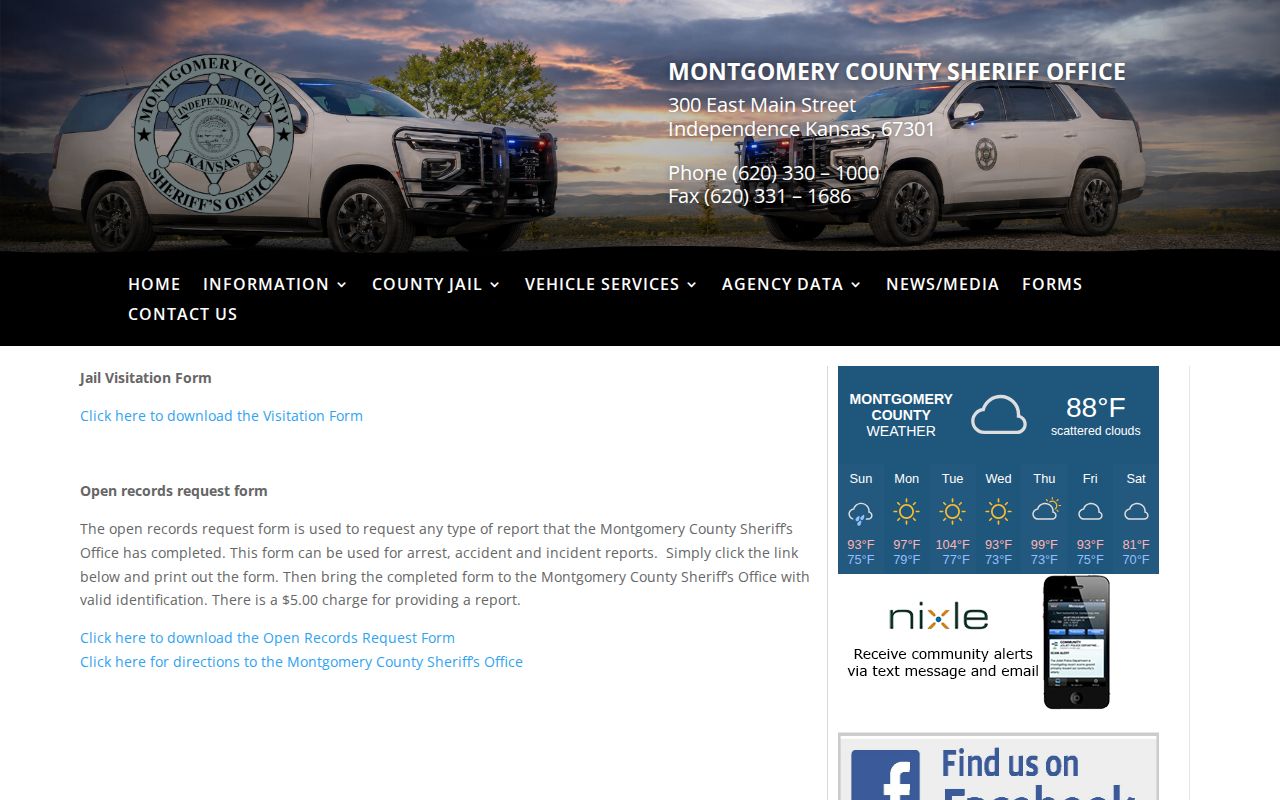
This source is the starting point for a focused Montgomery County booking and release request, not proof that every requested field will be open.
Montgomery County Release Record Law
The Kansas Open Records Act controls access to existing agency records. K.S.A. 45-218 requires an agency to act as soon as possible and by the end of the third business day. That action may be production, denial, or an explanation of delay with the earliest expected availability. It is not always a three-day production promise. K.S.A. 45-219 permits reasonable actual-cost fees and advance payment.
K.S.A. 45-217 excludes jail and correctional rosters from the definition of criminal-investigation records. That does not make every linked jail document open. K.S.A. 45-221 contains exceptions and rules for identifiable inmate and releasee records. It also supports separating closed material from releasable portions when practical. No county-specific retention term for the MCSO release sheet was verified, so ask whether the record still exists and which retention schedule applies.
Expungement can restrict public visibility. K.S.A. 21-6614 addresses conviction expungement, while K.S.A. 22-2410 addresses arrest-record expungement. A sealed or expunged case may no longer appear through the public portal. That absence is an access limit, not proof that the custody event never happened.
Montgomery County Release Times
Montgomery County publishes no fixed processing schedule, exit door, weekend rule, property-return procedure, or family waiting point. The official inmate-information page gives a narrower routing rule. Jail staff may confirm or deny present custody, while the Sheriff’s Office at 620-330-1000 supplies release times, bond amounts, charges, and court dates. Ask whether the time is scheduled or already completed.
The official page does not support a claim that every release occurs at the same hour. Holds, court changes, and transport can alter timing. Family members seeking practical release details should use the Sheriff line rather than wait at an assumed door. The manifest image of that MCSO responsibility notice shows which office handles each question.

The split matters: current custody and release-time information are phone services, while historical proof still calls for the completed release record.
Find Montgomery County Released Inmates
Start with the last known custodian. The current MCSO roster can establish that someone remains listed, but Montgomery County has no official released tab, archive, 24-hour feed, or 72-hour feed. Record absence must be followed by phone, VINE, court, and records checks. If the movement was to KDOC, federal custody, or ICE, shift to that receiving system.
- Search the MCSO roster by exact name and booking number. Match the date, agency, age, and photo.
- If absent, call MCSO. Ask for actual release time, disposition, and receiving agency.
- Check Kansas VINE for a county-jail custody change. Treat transfer separately from community release.
- Find the court case by party or case number and read the filed release, bond, sentence, probation, or commitment entry.
- If KDOC received the person, search KASPER and read current status, location, admission date, and movement history.
- For federal or immigration movement, use BOP, the federal docket, USMS, or ICE ODLS as appropriate.
- Request the MCSO booking/release sheet when online and phone results do not settle the event.
The MCSO live roster screenshot shows current booking fields and search controls, but no release-history control.
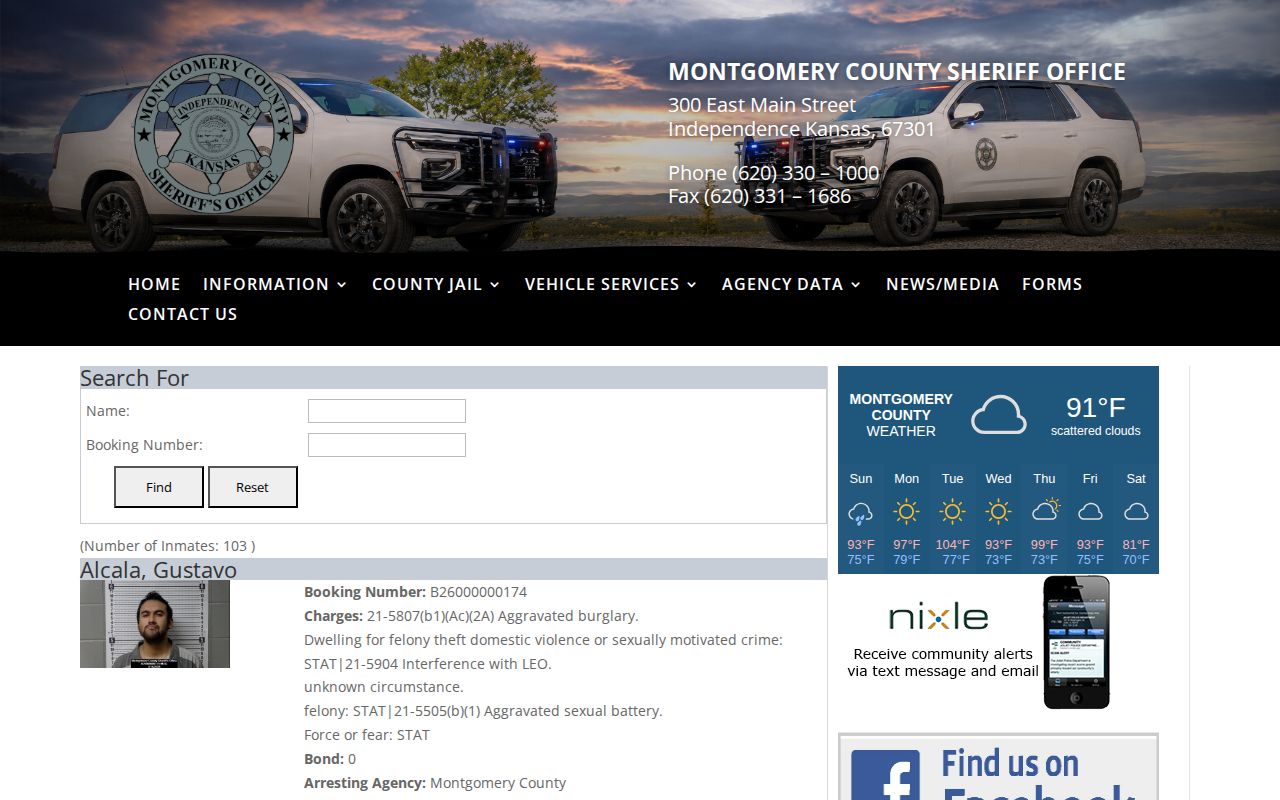
Use that roster to identify a booking and determine present listing status. Use the release record to prove what happened next.
KDOC Montgomery County Release Search
KASPER is the correct state lookup when a Montgomery County booking ends in KDOC admission or when a state prisoner later leaves an institution. It is not a county-jail release list. Accept the KASPER disclaimer, then search by name or KDOC number. Conviction County and Parole Supervision County can narrow results, but neither proves where the person lived or returned.
| Search field | Use |
|---|---|
| Last, first, middle name | Basic identity search |
| KDOC number | Best state-record identifier |
| Alias and photo controls | Widen and visually compare a result |
| KBI number or birth date | Advanced identity refinement |
| Conviction county | Narrow to a Montgomery County case |
| Parole supervision county | Narrow a state supervision result |
Read Current Status, Current Location, Admission Date, movement history, and the exact “Earliest Possible Release Date” label. A parole-office location or postrelease status supports prison departure with supervision still active. Maximum sentence discharge means KDOC supervision authority ended. Absconder is not discharge, and revoked or returned means custody resumed. KASPER updates each working day, not continuously, and cannot currently display Community Corrections probation events after April 21, 2021.
The manifest capture of the KASPER search documents the name, KDOC number, and advanced search routes.
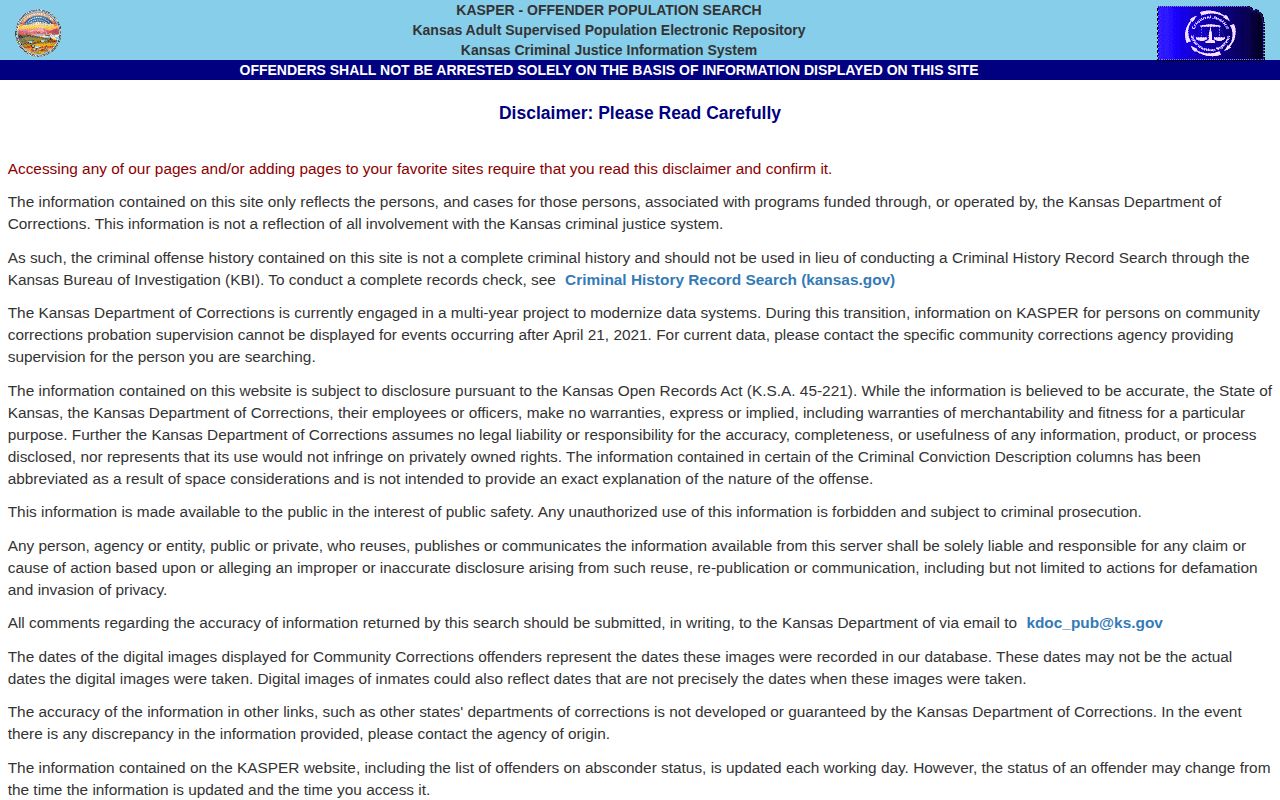
This statewide interface applies only when KDOC custody or supervision is part of the record.
Does Montgomery County Bond Prove Release?
No. The MCSO roster has a numeric Bond field, and the Sheriff can provide bond amounts and release times. A displayed amount is a condition and a useful lead. It does not establish payment, acceptance, completed paperwork, clearance of other holds, or physical departure. The court’s bond order explains the terms. MCSO’s completed movement entry confirms whether release occurred.
Ask for actual release time and the agency disposition after the bond process is complete. If another hold remains, the person may stay in custody or transfer despite a posted amount. A charge line with a planned release instruction is also not a standard release field. Confirm it through the Sheriff and the court case.
Montgomery County Release Court Records
The Fourteenth Judicial District separates Independence criminal dockets from Coffeyville traffic and criminal dockets. The roster’s Arresting Agency field helps choose the likely local docket, but the case number is the durable link. Through the Kansas District Court records route, look for bond and release orders, dismissal, sentencing, jail credit, probation, revocation, or commitment to KDOC.
Case information and filed documents are not the same. Some older converted documents may be absent online yet remain public at a courthouse terminal. Protected, sealed, expunged, and many juvenile matters do not appear publicly. A missing portal result can reflect an access limit. The court event explains authority for release, while the jail record confirms the physical act and time.
The successful manifest capture of Kansas Courts record guidance distinguishes remote portal access from courthouse access.
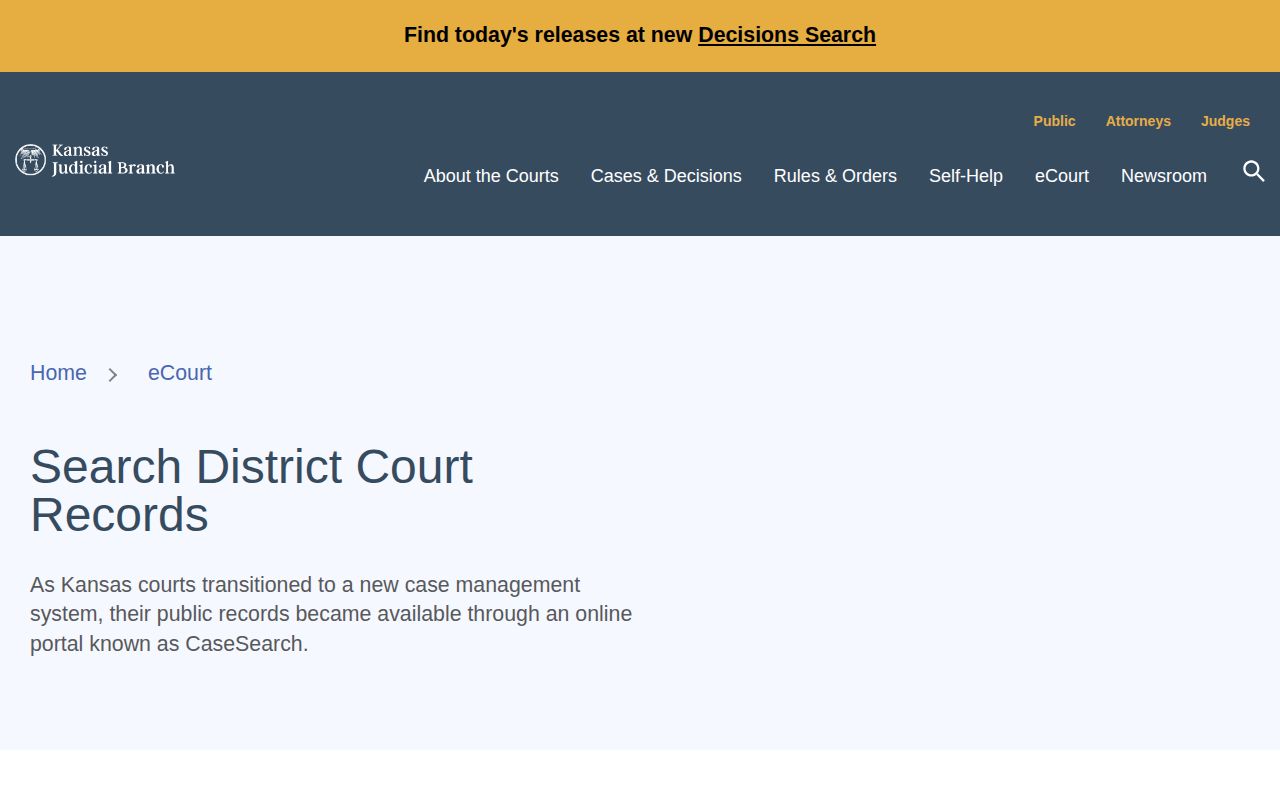
Use the local case number, party, and exact journal entry when requesting a document from the clerk.
Montgomery County Release Follow-Up
Kansas VINE covers adults in participating Kansas county jails, including the county-jail lane relevant to Montgomery County. A released or out-of-custody result corroborates departure from the reporting jail, but it may not name a community destination. VINE expressly does not cover KDOC prison offenders. KDOC Victim Services has a separate notification form and contact channel for a person in KDOC custody or supervision.
State parole and postrelease status are checked in KASPER, then clarified through the Coffeyville Parole Office when needed. Local felony probation is different. Fourteenth Judicial District Adult Community Corrections in Independence supervises qualifying Montgomery and Chautauqua County cases. A court journal entry establishes probation, while the local office addresses current supervision within lawful disclosure limits. The KBI registered-offender search is useful only when a qualifying registration duty applies; it is not a general release list.
Which record shows supervision? Use KASPER for KDOC parole or postrelease, Adult Community Corrections for local felony probation, and the federal docket for federal supervised release. Do not treat community supervision as incarceration or as a completed discharge.
Montgomery County Release Transfers
A roster disappearance can hide a federal or immigration handoff. For a sentenced federal person, the BOP Inmate Locator searches records from 1982 forward by number or name and can show a release date with “Released” or “Not in BOP Custody.” Those labels mean BOP is no longer the custodian. Another local, state, federal, or immigration authority may still hold the person. USMS has no comparable nationwide public locator, so pretrial or transport custody is checked through the federal docket, the holding facility, and the District of Kansas.
An immigration detainer may produce a transfer to ICE. The ICE Online Detainee Locator System accepts an exact nine-digit A-number with country of birth, or name, date of birth, and country of birth. A missing result does not prove community release. No local ICE detention facility or Montgomery County ICE contract was verified in the official sources reviewed, so an ICE check should not be read as evidence that a local immigration jail exists.
The manifest image of the BOP locator shows both identifier and name search routes for a federal record.
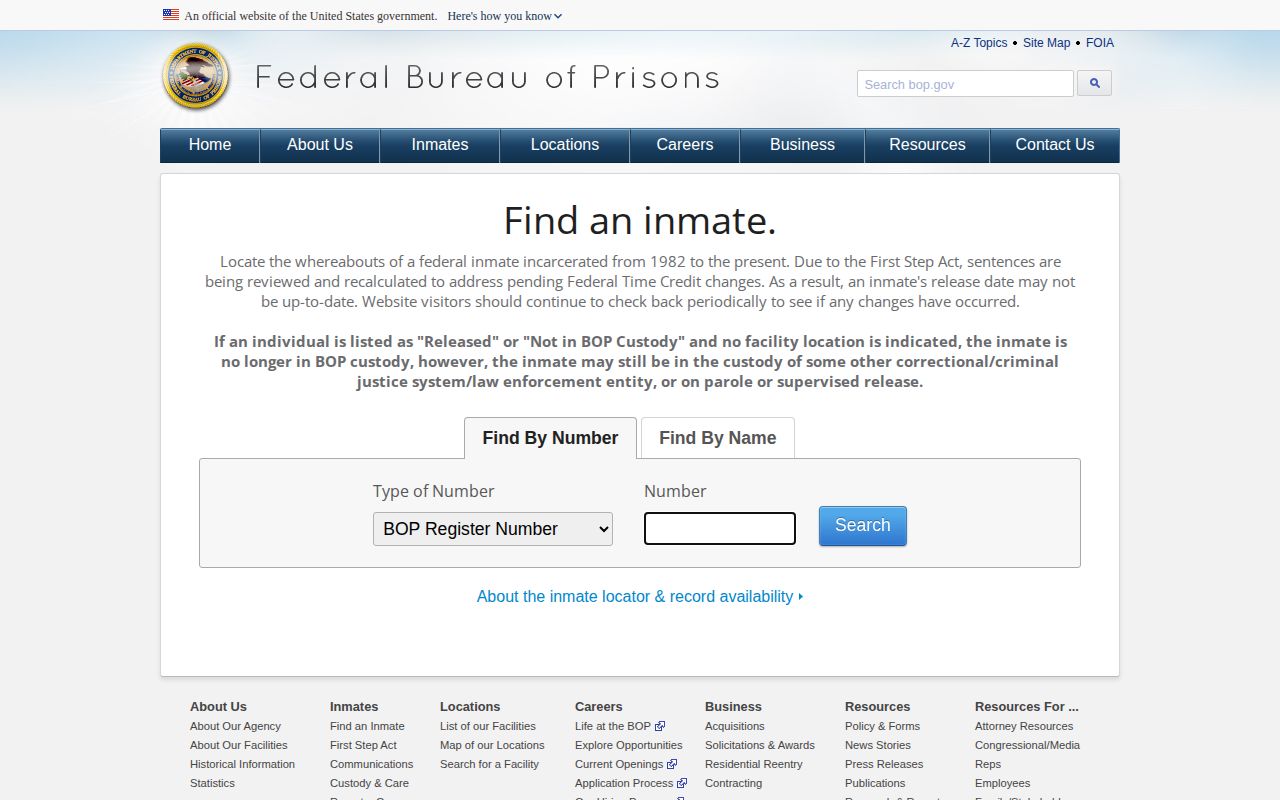
A BOP release result should be paired with the case docket and any county transfer record before the destination is described.
Compare Montgomery County Release Sources
Use the source that owns the relevant custody event. This avoids treating an in-custody roster, a forecast date, or another agency’s transfer as a completed Montgomery County community release.
| Situation | Primary source | What confirms |
|---|---|---|
| Still in county jail | MCSO roster and Jail phone | Present county listing or custody confirmation |
| Left county jail | MCSO release sheet, VINE, court | Actual departure, reason, and legal authority |
| Entered or left state custody | KASPER and KDOC | Admission, movement, current status, or discharge |
| Federal custody ended | BOP locator and federal docket | BOP status, date, and case conditions |
| Possible ICE handoff | ICE ODLS and ERO | Receiving immigration custody when shown |
When sources disagree, compare the booking number, KDOC number, case number, dates, and agency. Ask the record custodians to resolve the mismatch. Never collapse distinct custody systems into one result.
Montgomery County Release Facilities
Three custody lanes serve local cases. The Montgomery County Jail / Department of Corrections is the primary adult county jail. A community release, county transfer, or handoff starts with its MCSO record. Kansas Adult Correctional Facilities are outside Montgomery County and hold people committed to KDOC; KASPER documents state admission, supervision, and discharge. Federal Custody Serving Montgomery County covers District of Kansas cases handled through USMS, contract custody, or BOP.
No separate long-term adult municipal jail was verified in Independence or Coffeyville. Their police departments may appear as arresting agencies on the county roster, but MCSO remains the county custodian. Likewise, no KDOC adult prison, federal prison, or ICE detention center was verified inside Montgomery County. The arresting agency tells who initiated the booking. The custody and movement records tell where the person actually went.
Note: Municipal arrest processing does not create a separate release archive; use the county booking number and the correct local court docket.
Public Record Search
Sponsored Results