
Montgomery County Scheduled vs Actual Release
A scheduled or earliest date is a planning field. An actual release is a completed movement. Kansas KASPER uses the exact label Earliest Possible Release Date (EPRD), not “projected release date.” Its footnote says Board action and good-time or program credit can affect the date. Read EPRD with Current Status, Current Location, Admission Date, movement history, sentence type, and case details.
A Montgomery County pretrial detainee has no sentence-based EPRD. Bond, a hearing, dismissal, plea, or other court action may change custody, but the date is not fixed until the legal and operational steps are complete. A county-jail sentence follows the court’s journal entry, credited time, lawful jail policy, sanctions, and holds. A KDOC sentence follows state computation rules.
Find a Montgomery County Release Date
Start with the agency now holding the person. The live MCSO roster proves current display, not a past release or state transfer. KASPER is for KDOC-associated records and should not be used as a Montgomery County jail archive.
- For state custody, open the official KASPER disclaimer, accept it, and search by KDOC number or matched name.
- Open the correct detail record and locate Earliest Possible Release Date, Current Status, Current Location, convictions, and movement history.
- For a jail-only sentence, ask MCSO for actual or scheduled release information and use the booking number in a focused records request.
- Read the Fourteenth Judicial District journal entry for the sentence, jail credit, amendments, and holds shown in the case.
- If parole eligibility applies, distinguish the public-comment date, hearing date, possible eligibility, and actual movement.
- Confirm completion with the jail, KDOC status, or the receiving agency rather than relying on one date.
The Sheriff’s Office at 620-330-1000 is the official route for release-time questions. The Jail may confirm present custody. Historical facts may require the MCSO records form and completed release sheet. The broader Montgomery County release-record search explains the county record chain.
KASPER Date Fields for Montgomery County
KASPER can be searched by last, first, and middle name or KDOC number. Alias search, photos, and advanced fields help separate similar people. Advanced filters include KBI number, race, gender, birth date, age range, conviction county, and parole supervision county. A Montgomery conviction does not prove the person will return to Montgomery County.
The detail record may show admission date, status, location, custody level, programs, convictions, movement and discipline history, and EPRD. KASPER updates each working day, not in real time. A prison location means the person has not left KDOC custody. Parole or a parole-office location means prison release may have occurred while supervision continues. Maximum sentence discharge means KDOC authority ended.
The official KASPER disclaimer is shown in this captured source:
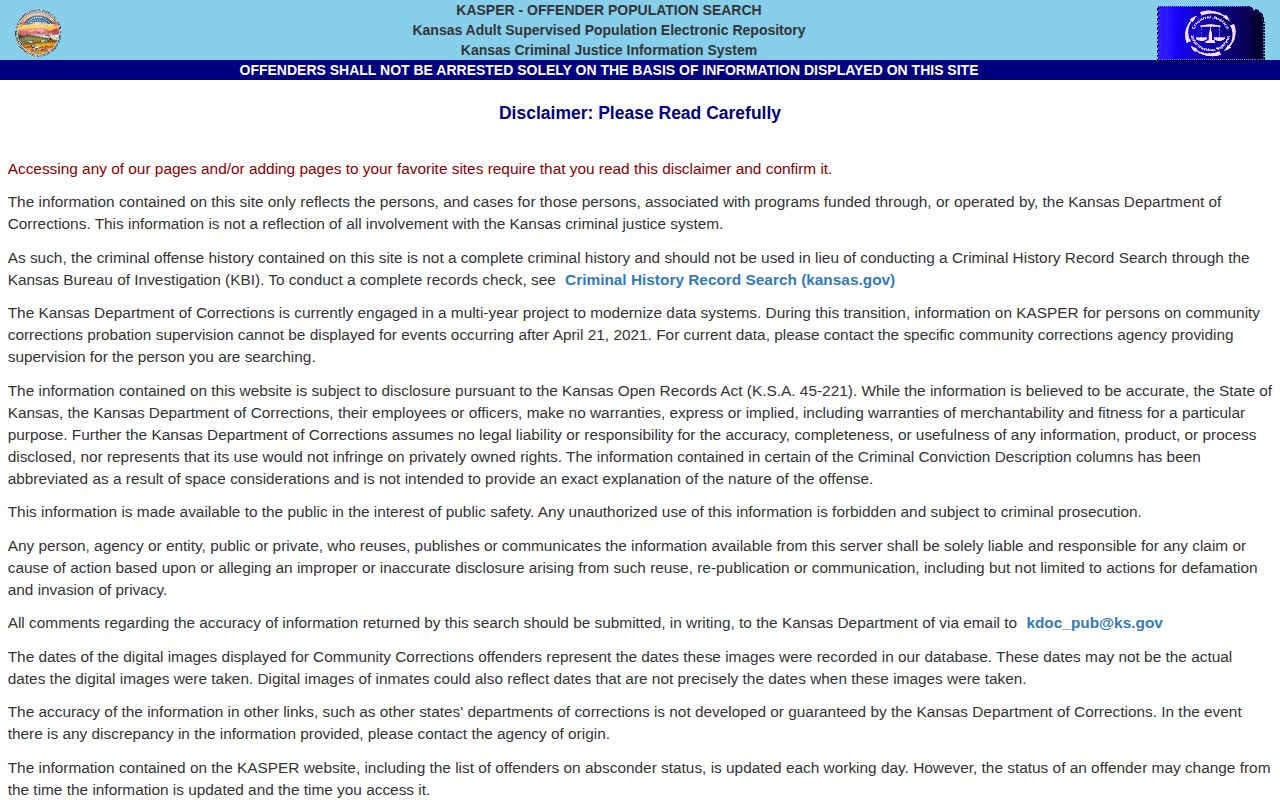
The capture reinforces why EPRD and status need agency confirmation rather than a simple date-only reading.
Montgomery County Good-Time Rules
K.S.A. 21-6821 authorizes KDOC good-time calculations, earning rules, and forfeiture. For crimes committed on or after July 1, 1993, the amount subtracted from the prison portion is generally capped at 15 percent. That cap produces the common “serve about 85 percent” shorthand. It is a maximum credit framework, not an automatic promise.
A 20 percent cap applies to listed offense-date and severity groups, including certain nondrug severity-level 7 through 10 crimes committed on or after January 1, 2008. It also applies to specified drug severity groups across statutory date ranges. Offense date and severity therefore control. Credit may be earned, withheld, lost, restored, or recalculated.
The statute page documents the Kansas rules in the following successful capture:
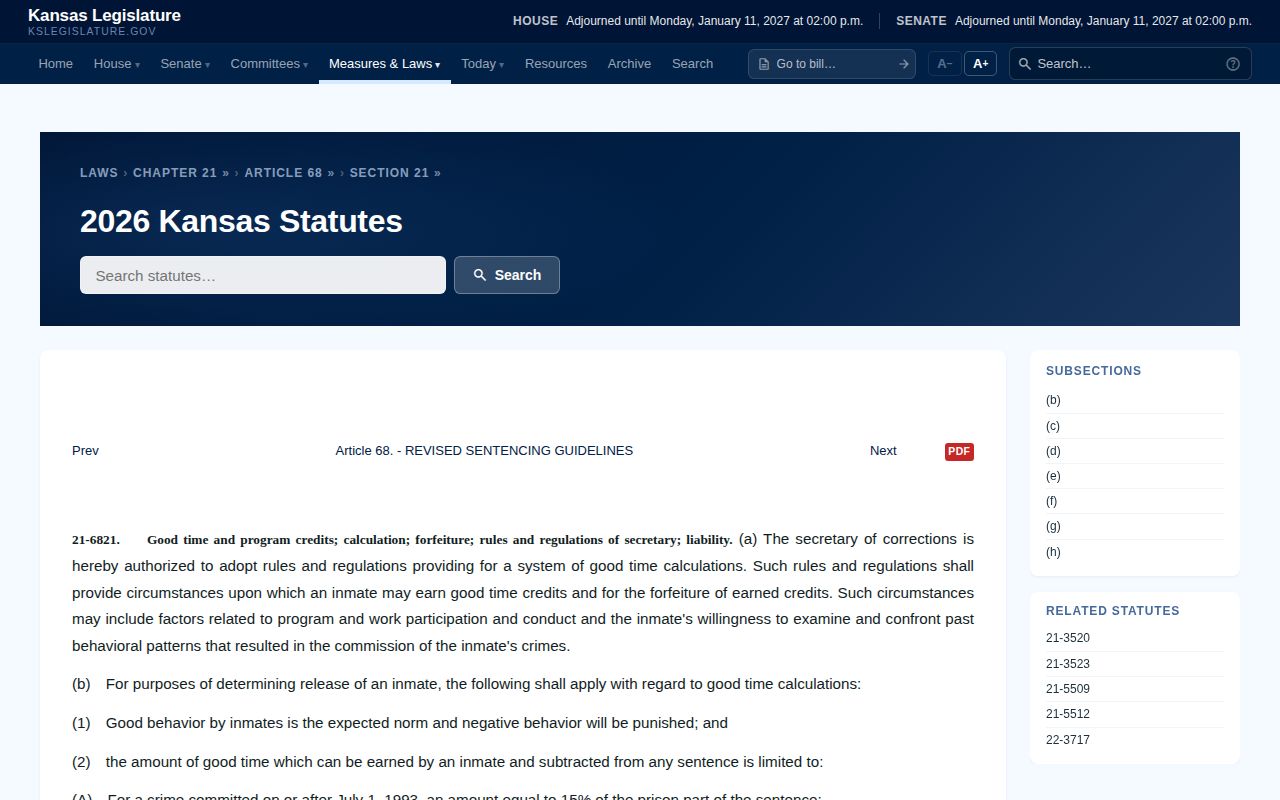
The text supports a statutory calculation framework, not a promise that every person receives the full percentage. Final confirmation still requires the completed movement record.
Montgomery County Program Credit
K.S.A. 21-6821 permits eligible program credit for completion of a GED, technical or vocational training, substance-use treatment, or another Secretary-designated program shown to reduce post-release risk. Program credit is capped at 120 days. It is not a universal extra four months, and completing a sex-offender treatment program alone does not create that credit.
Eligibility depends on offense severity and sentence structure. For certain sexually violent or motivated offenses, credit removed from prison may be added to postrelease supervision. A calculation that simply subtracts 120 days, 15 percent, or 20 percent can be wrong. KASPER’s EPRD reflects the agency calculation available for the record.
Montgomery County Parole Date Limits
K.S.A. 22-3717 governs parole eligibility and contains offense-date and offense-type rules. Eligibility is permission for consideration, not a release grant. Life without parole is not eligible. Certain murder and off-grid terms have special minimum-service rules without normal good-time deductions.
For applicable older indeterminate sentences, KDOC explains that good time can change eligibility and conditional-release points. The Prisoner Review Board can parole, continue, or pass. A continue postpones a decision; a pass denies parole for a stated period. Even a grant may be followed by processing, conditions, or another hold before movement.
The Prisoner Review Board process is shown in this source capture:

The Board’s separate outcomes explain why hearing and eligibility dates must not be reported as release dates.
The maximum sentence discharge certificate addresses final termination of KDOC authority. A county release sheet records physical movement from the jail. A filed journal entry explains a legal sentence change. These documents answer different date questions and should not replace one another when confirming a Montgomery County release.
What Changes Montgomery County Dates
A computed date can move for reasons that appear in different records. Compare the sentence, KDOC calculation, court orders, discipline, and movement rather than estimating from the term alone.
| Factor | Possible effect | Record to check |
|---|---|---|
| Good time | Earned, withheld, restored, or forfeited | KDOC calculation and discipline history |
| Program credit | Posted after eligible completion | KDOC record |
| Sentence structure | Concurrent or consecutive terms alter computation | Court journal entry |
| Custody credit | Prior jail time is corrected or recalculated | Court and KDOC records |
| Board action | Parole, continue, or pass changes the path | PRB and KASPER |
| Hold or detainer | Blocks community departure after one term ends | Holding and receiving agencies |
| Revocation | Returns a supervised person to custody | KDOC status and movement |
County Jail Dates Are Different
KASPER’s EPRD is not a calculator for a Montgomery County jail-only sentence. No public MCSO county good-time policy or weekend or holiday adjustment rule was verified. Do not import KDOC’s 15 or 20 percent rules into a county sentence. The court’s sentence, credited time, lawful county policy, sanctions, holds, and the jail’s operational record control.
Free-text charge information on the live roster may sometimes contain a sanction and planned release instruction. It is a lead, not a normalized release field. Confirm completion with the Sheriff and release sheet. A detainer may move the person to KDOC, another county, federal custody, or immigration custody instead of the community.
Confirm Montgomery County Actual Release
For state custody, read Current Status and movement after the EPRD. For county custody, call the Sheriff and request the completed record. A Kansas VINE alert can corroborate a participating county-jail custody change, but it does not cover KDOC prisons. The separate Montgomery County VINE inmate check explains registration and transfer limits.
Final state discharge is different from release to supervision. Ask for the maximum sentence discharge certificate when the question is whether KDOC authority ended. When a court change controls the date, obtain the filed journal entry. Each record answers a different part of “when did they get out.”
Kansas determinate and indeterminate sentences require different readings. Guideline determinate terms generally apply to crimes committed on or after July 1, 1993. The prison portion is followed by postrelease supervision, less lawful good time. In some categories, credit removed from incarceration is added to postrelease supervision. A shorter custody portion therefore does not always shorten the whole correctional obligation by the same amount.
Older indeterminate terms can depend on a judicial minimum, maximum, retained good time, and Board action. KDOC explains that a minimum of two years or more may reach parole eligibility at half the minimum if all applicable credit is retained. A one-year minimum reaches eligibility after nine months. Conditional release generally occurs after half the maximum when credit is retained. Special offense rules and the individual sentence still control.
Parole suitability is separate from eligibility. The Board may parole, continue, or pass. K.S.A. 22-3717 contains special rules for life, murder, off-grid, and other sentence classes. It is inaccurate to apply a general percentage without reading the offense date, severity, sentence, and statutory category.
A hold may control departure. Another county, KDOC, a federal authority, or immigration enforcement may take custody after one term reaches its date. The date can be right for one case while the person never enters the community. Verify through the receiving agency.
Read Montgomery County Date Records
Record dates should retain their source labels. A booking date marks entry. A hearing date marks a legal event. EPRD is an earliest computed possibility. A VINE alert marks a reported jail custody change. A release sheet records operational departure. Keeping those labels intact prevents an estimate, hearing, or scheduled time from being mistaken for completed release.
KASPER movement can explain a change after a roster disappearance. Admission to KDOC is continued custody. A parole-office location suggests the prison portion ended while supervision remains. Revocation shows an earlier release followed by renewed custody. Maximum sentence discharge is the endpoint for KDOC authority.
Sentence math may involve several cases. Consecutive terms can extend the period, while concurrent terms may overlap. Jail credit and later amendments can alter the base. Discipline can reduce expected credit. Outside arithmetic cannot replace the agency EPRD and filed court record.
No official Montgomery County release-processing hour, weekend rule, waiting point, or county good-time formula was found. The Jail confirms current custody and the Sheriff handles release-time questions. Call before acting on a planned time. Bond processing, paperwork, court action, and holds can intervene.