
Kansas State Custody from Montgomery
Kansas Adult Correctional Facilities serving Montgomery County commitments are state prisons operated by KDOC outside the county. This is aggregate statewide coverage, not a page for one local building. When a Montgomery County court commits a person to state prison, the physical move begins as a departure from the Montgomery County Jail. That county event may look like a release on the MCSO roster, but it is a transfer into state custody rather than a return to the community.
The correct evidence chain joins the MCSO release or transfer sheet to a KASPER admission. The county record identifies the booking, actual departure time, and receiving authority. KASPER can then show the KDOC number, admission date, current status, current location, conviction case, and movement history. Processing and the working-day update schedule may create a gap between those records, so a same-day missing result should not be read as proof that the transfer failed.
| Custody event | Controlling record | Meaning |
|---|---|---|
| County jail departure to KDOC | MCSO release or transfer sheet | County custody ended; state custody begins |
| State admission | KASPER admission and location | KDOC accepted the commitment |
| Prison departure | KASPER status, location, and movement | Institutional custody ended, often with supervision |
| Maximum sentence discharge | KDOC discharge record or certificate | KDOC supervision authority ended |
Search KDOC Montgomery Commitments
KASPER means Kansas Adult Supervised Population Electronic Repository. It covers people committed to KDOC and people in KDOC-associated custody or supervision. It is not a Montgomery County jail roster, a full criminal-history file, or a reliable ledger for ordinary local probation. Begin at the official KASPER disclaimer, accept its terms, and search the matched person.
- Use the KDOC number when known. Otherwise enter the last and first name, with middle name or alias only as needed.
- Use Show Photos or thumbnail controls to help compare identity. A database image date may not be the date the photo was taken.
- Narrow with birth date, KBI number, age range, race, gender, Conviction County, or Parole Supervision County when the name returns several records.
- Open the detail record and match the Montgomery County case, sentencing data, KDOC number, and admission date.
- Read Current Status and Current Location together. Then check movement history and sentence fields before describing a release.
The successful manifest capture of the KASPER offender search shows the statewide name, KDOC number, alias, photograph, and advanced search controls.
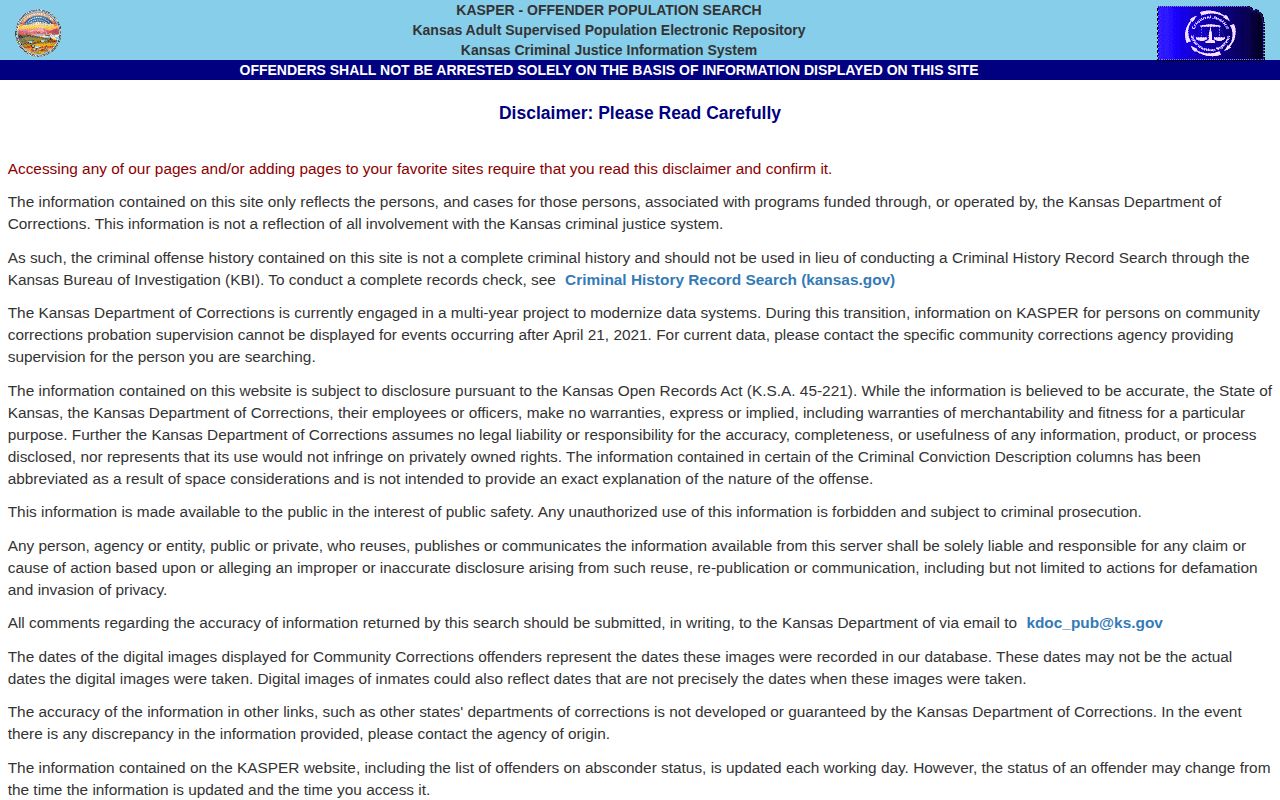
Conviction County can help locate a Montgomery County commitment, but it does not establish the person’s home, supervision county, or release destination.
Read Kansas Release Status Correctly
A KASPER result needs more than one field. A prison facility and incarceration status mean the person remains in KDOC institutional custody. A parole-office location or postrelease status supports departure from prison while state supervision continues. Conditional release is a statutory release point for an indeterminate sentence and generally leaves supervision in place through the maximum. An absconder was in the community and is reported missing or noncompliant; that label is not discharge. A revocation or return means a prior release occurred but custody resumed.
- Parole
- Release from prison after Board action on a parole-eligible sentence, with supervision still in force.
- Postrelease supervision
- The prison portion of a determinate sentence ended, but KDOC supervision continues.
- Conditional release
- A statutory release point for an eligible indeterminate sentence, normally followed by supervision.
- Maximum sentence discharge
- The Kansas sentence and KDOC supervision authority have ended.
For final state termination, ask KDOC for or confirm the maximum sentence discharge certificate. A field-office result does not prove discharge. The local state contact is the Coffeyville Parole Office, which serves Montgomery, Wilson, and Chautauqua Counties. KASPER updates each working day rather than in real time, so contact KDOC when a recent movement is missing or the status conflicts with another official record.
State-prison release is not the same as county-jail release. KASPER and KDOC control the state event after admission.
Earliest Possible Release Date
Kansas labels its public planning field Earliest Possible Release Date, often shortened to EPRD. It is the closest KASPER field to what many readers call a projected release date. The wording matters. EPRD describes an earliest possibility under the current record. It is not a guaranteed departure date and does not prove that a person left prison when a displayed date passed.
KASPER states that Board action and good-time or program credit can affect EPRD. Read the date with Current Status, Current Location, Admission Date, sentence type, movement history, and the underlying case. A future date can move. A past date still needs a status or movement showing that the departure occurred. A hold or detainer may also prevent community departure even when one sentence reaches a date.
| Factor | Possible effect on EPRD |
|---|---|
| Good-time credit | Earned, withheld, restored, or forfeited credit changes the prison calculation |
| Eligible program credit | Posted credit may change the date within statutory limits |
| Sentence correction | Concurrent, consecutive, jail-credit, appeal, or court changes alter the calculation |
| Prisoner Review Board action | Parole, continue, or pass changes the path for an eligible sentence |
| Violation or detainer | Return to custody or another hold can prevent the expected departure |
Do not apply the KDOC EPRD or state good-time formula to a Montgomery County jail-only sentence. No public MCSO county good-time policy or routine weekend adjustment was verified. County release timing comes from the court sentence, jail credit, holds, and MCSO’s completed movement record.
Kansas State Sentence Credits
K.S.A. 21-6821 authorizes KDOC good-time calculations, earning rules, and forfeiture. For many crimes committed on or after July 1, 1993, the maximum reduction from the prison portion is 15 percent. That rule produces the common 85-percent shorthand. It is not an automatic award. Credits can be lost, withheld, or recalculated, and offense date, severity, sentence structure, and misconduct matter.
The statute uses a 20-percent cap for certain nondrug severity-level 7 through 10 crimes committed on or after January 1, 2008. It also applies a 20-percent cap to specified drug-severity groups and date ranges. Eligible program credit can be awarded for listed education, training, treatment, or other approved programs, up to 120 days. That cap is not a promise of four months for every person. Eligibility and completion must be established.
For some sentences, credit removed from the prison portion is added to postrelease supervision. That can shorten institutional custody without reducing the full correctional obligation by the same span. Parole eligibility under K.S.A. 22-3717 is also not a release decision. The Prisoner Review Board may parole, continue, or pass an eligible person, and specialized sentence rules can require different minimum terms.
KDOC Release Records and Contacts
KASPER is the public starting point, not the only record channel. The detail can include admission, location, status, movement, conviction, sentence, disciplinary, and supervision information. K.S.A. 45-221 allows KDOC to close some identifiable correctional information while listing categories that may be disclosed, including names, photographs and identifiers, sentence data, parole eligibility, custody or supervision level, disciplinary information, supervision violations, non-treatment conditions, and facility or parole-office location.
A focused KDOC request should identify the person and KDOC number, then ask for the release date and type, relevant movement or status record, and maximum sentence discharge certificate when final termination is the issue. Request releasable portions if other fields are withheld. Corrections to KASPER public data may be sent to kdoc_pub@ks.gov.
Coffeyville Parole Office
102 W. 7th Street, Suite 309
Coffeyville, KS 67337
620-625-7925
Serves Montgomery, Wilson, and Chautauqua Counties
KDOC State Contacts
Parole Services Automated Reporting System: 866-570-7225
KDOC Victim Services: 1-866-404-6732
Email: VictimWitness@doc.ks.gov
KASPER corrections: kdoc_pub@ks.gov
Kansas VINE is not the prison notification system. It covers adults in participating Kansas county jails and expressly excludes KDOC prison offenders. For a person in a KDOC facility or under KDOC supervision, use the separate KDOC Victim Services notification form. KDOC says that program is not for a person only in county jail, on ordinary probation, or in Community Corrections outside KDOC coverage.
Where Kansas Prison Releases Go
A Kansas prison departure can lead to parole, mandatory postrelease supervision, conditional release, another jurisdiction, or maximum discharge. KASPER may show a community field-office location when prison custody ends and KDOC supervision begins. The Coffeyville office is the relevant local state-parole contact for Montgomery County, but supervision county does not prove a person’s home address or the county where the conviction occurred.
A transfer to another custodial authority is not a community release. Federal or immigration holds can change the destination even when the Kansas prison term reaches a release point. A federal receiving record belongs in BOP, USMS, or the federal case. An ICE handoff belongs in the ICE detainee locator and ERO channel. No KDOC adult prison, federal prison, or ICE detention center was verified inside Montgomery County.
The KASPER disclaimer also warns about coverage, update timing, abbreviated conviction descriptions, and data limitations.
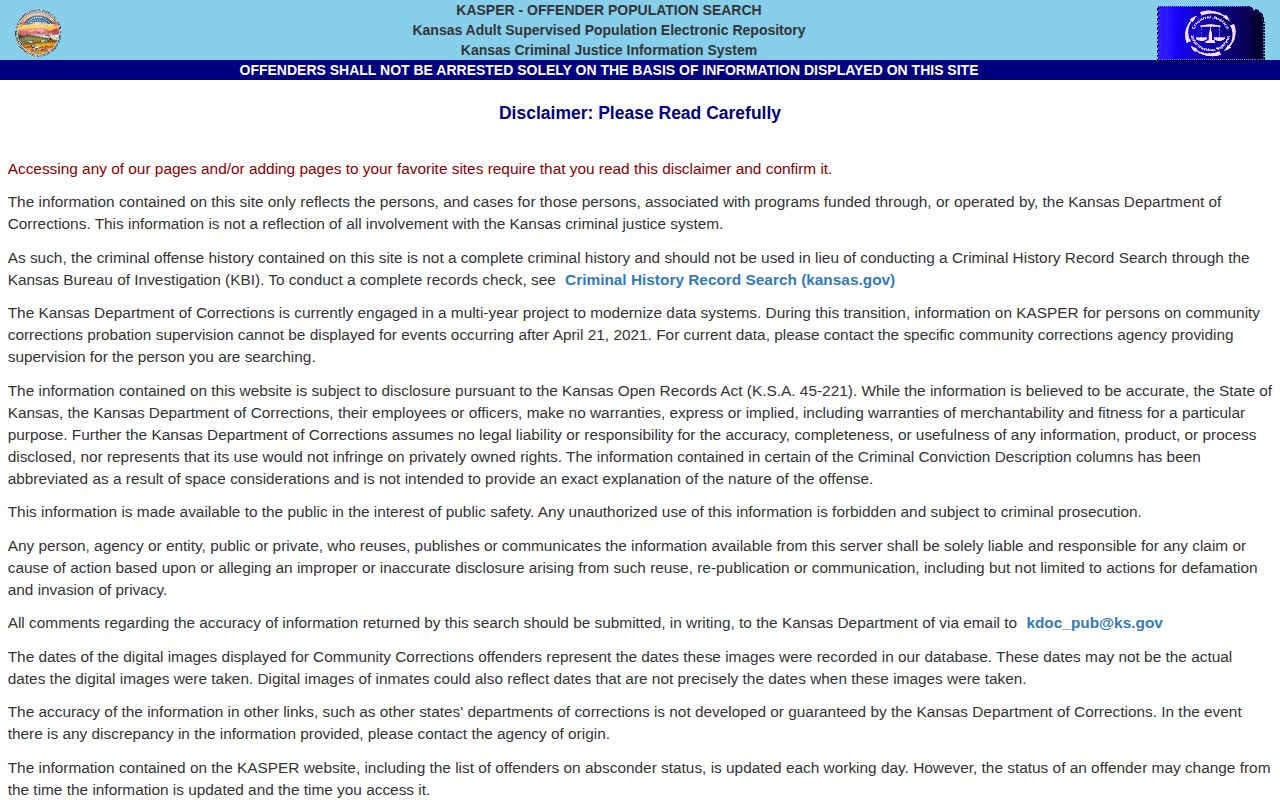
Those cautions make KASPER a strong state source when its fields are read together, while telephone or written KDOC confirmation remains appropriate for a recent or unclear discharge.
Note: A state field-office location shows release from prison with supervision, not completion of the Kansas sentence.
Public Record Search
Sponsored Results